
How An Immigration Lawyer Grew Organic Traffic by 847% in 11 Months
-case study
Professional Service
Topical Authority
Full-Stack SEO
Generative Engine Optimization
1.7K
High Intent Organic Keywords
36.5%
AI Citation Growth
200%
Organic Visit Increased
60%
SERP Dominance
The Starting Point Nobody Talks About
— Introduction
When Immigration Law Firm first reached out, they had a decent enough website. It was Professional-looking, clearly built by someone who understood law firms; but it was essentially a ghost online. A few dozen keyword rankings, mostly branded. Monthly organic traffic hovering somewhere around the 200-visitor mark on good days. The kind of baseline that makes the work feel both daunting and exciting, because there’s nowhere to go but up.
What the firm had going for it was substance. A lead attorney with nearly fifteen years of hands-on immigration casework, a small but dedicated team, and a real depth of knowledge that wasn’t showing up anywhere on the site. The expertise was locked inside their heads and their case files. My job was to get it onto the page and increasingly, into the AI systems that were starting to reshape how people find legal help.
The firm’s primary service area was Chicago, with some reach into North Carolina markets. They were fielding consultations on H-1B petitions, family-based immigration, visa bulletin strategy, USCIS process navigation, and naturalization. The full spectrum. The problem was that none of that expertise was translating into discoverability.
Reading the Room
– prerequisites
Before we touched a single page, we spent almost a week doing what most agencies skip in favor of looking busy: listening.
We read through the questions clients were sending via email before their consultations. We looked at what the front desk was fielding on the phone.
This is something we’ve started doing with every legal client because Google’s understanding of search intent, and now AI systems’ synthesis of user queries, have both gotten sharp enough that you can’t guess your way into relevance anymore. You have to understand what someone is actually afraid of when they type “h1b appointment rescheduled” at 11pm on a Tuesday.
That keyword which they’d later rank #2 for isn’t a curiosity. That’s someone in genuine distress. Their visa timeline just got disrupted and they need clarity fast. When we identified that emotional layer underneath the informational queries, the content strategy basically wrote itself.
The technical audit revealed the usual suspects:
- slow mobile load times
- thin service pages
- zero structured data markup
- no local schema
and a blog that hadn’t been touched in about fourteen months. The blog existed mostly to satisfy a checkbox someone had ticked years ago.
The Strategy We Actually Ran
– actions
Phase 1: Technical Foundation (Months 1)
We started with the infrastructure because content built on a shaky technical base is content that underperforms. Core Web Vitals were addressed first: image compression, render-blocking script cleanup, and a server-side caching implementation that brought the Time to First Byte down to under 400ms. Not glamorous work. Essential work.
Structured data markup was added across the board:
- LegalService schema on all practice area pages
- FAQPage schema on any page containing Q&A content
- LocalBusiness schema with precise NAP consistency
- BreadcrumbList schema sitewide
We were already thinking about AI-readability at this stage. Large language models and AI Overviews parse structured data. If you want to be cited, your content needs to be structured clearly enough that a machine can extract and attribute it confidently.
We also rebuilt the internal linking architecture from scratch. The site had orphaned pages that had been indexed but never linked to.
We created a hub-and-spoke content model where the core practice area pages served as hubs, and supporting informational content pointed back to them with contextually relevant anchor text.
Phase 2: Content That Actually Answers Something (Months 2–6)
This is where most of the heavy lifting happened, and also where the results started separating from the competition.
The content strategy had three distinct tiers:
Tier 1: Immigration law moves fast. USCIS policy changes, visa bulletin updates, biometric requirement shifts; these create what we call “urgency gaps” in search.
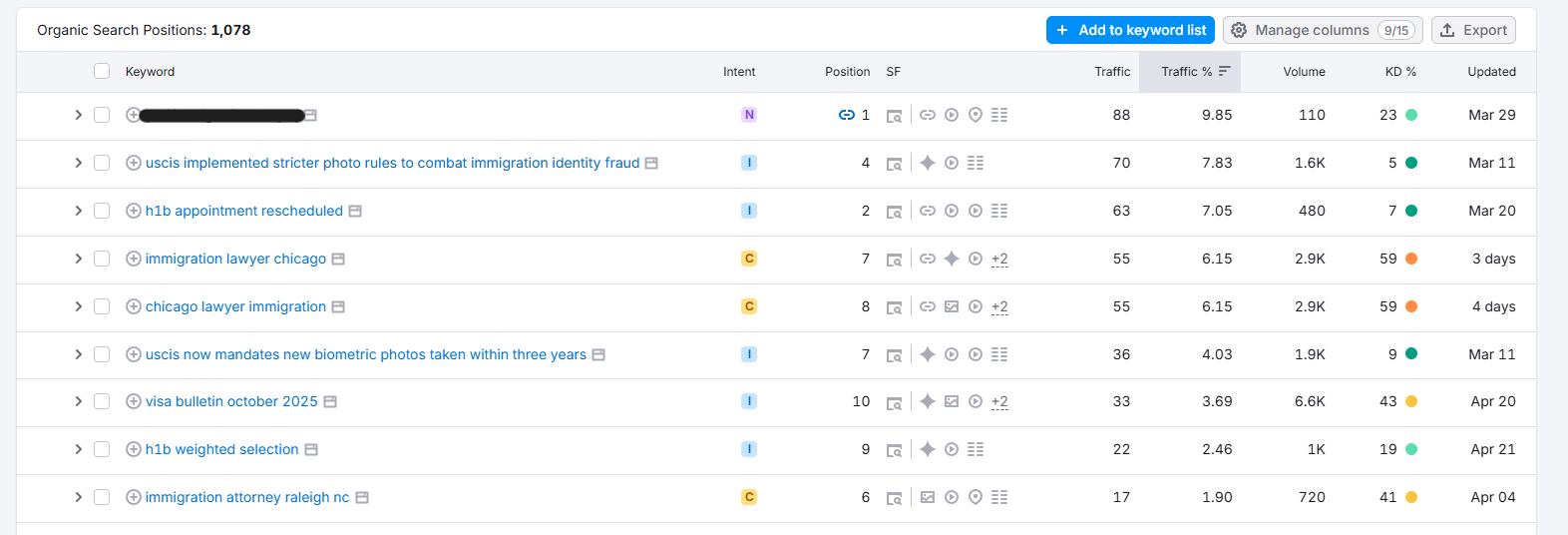
When USCIS announced stricter photo requirements to combat identity fraud, we had an in-depth explanatory piece live within 36 hours. That page eventually ranked #4 for the query with 1.6K monthly searches, and another version of that content covering the biometric photo mandate landed at position #7 for nearly 2K monthly search volume.
Both at KD scores of 5 and 9 respectively meaning the competition essentially wasn’t showing up for these. The lead attorney had a standing agreement to review and comment on regulatory changes within 24 hours of our drafting. That speed-to-publish advantage, combined with genuine expertise in the content, is what creates the early-mover rankings on news-adjacent legal queries.
Tier 2: Process and How-To Content. Queries like “h1b weighted selection” and “h1b appointment rescheduled” represent people navigating confusing bureaucratic processes. These pages were written as genuine guides not padded, not vague, not hedged into uselessness. Specific steps. Real timelines. Honest acknowledgment of where the process is unpredictable.
The H-1B weighted selection page ranked at position #9 with solid traffic at relatively low KD. The appointment rescheduling page climbed to #2.
Tier 3: “Immigration lawyer Chicago” and “Chicago lawyer immigration” were the commercial targets; both sitting around 2.9K monthly volume with KD in the 59 range.
We rebuilt those service pages with geo-specific content, embedded Google reviews markup, updated the Google Business Profile extensively, and ran a local citation cleanup campaign. They’re sitting at positions 7 and 8 in the game, but with room to climb.
The blog was replaced with a genuine resource center. We published between 8 and 10 pieces per month, varying between long-form guides (2,500+ words), shorter timely updates (600–900 words), and FAQ-formatted content specifically designed for AI Overviews and featured snippets.
Phase 3: AEO, AI Search Optimization and Link Building (Months 4–11)
This is where the strategy gets more interesting, because we were operating in territory that didn’t have a clean playbook when we started.
The shift toward AI-generated search results: Google’s AI Overviews, ChatGPT’s search integrations, Gemini means the game is no longer just “rank in position 1.” It’s “get cited by the machine that’s synthesizing the answer.” Those are related but different goals.
we approached AISEO through four lenses:
-Citability
Content needs to be written in a way that makes it easy to quote. Short, declarative statements. Factual claims with clear sourcing. Concise definitions followed by elaboration. We restructured existing content to front-load answers rather than building to them journalistically. The inverted pyramid, applied aggressively.
-Entity authority
We worked on building the firm’s entity footprint across the web. Consistent citations on legal directories (Avvo, Justia, FindLaw, Martindale), mentions in local business publications, and proper schema markup that established the lead attorney as a named legal expert on specific immigration topics. LLMs learn what sources to trust partly by how well-attested an entity is across authoritative sources.
-Conversational keyword coverage
AI queries are longer and more natural than traditional search queries. We added content targeting phrasing like “what happens if my H-1B appointment is rescheduled by USCIS” and “how does the H-1B weighted selection lottery actually work”; questions people are literally asking ChatGPT and Gemini. These don’t have traditional search volumes that SEO tools pick up well, but they drive AI citation.
-FAQ and structured Q&A content
Every major service page got a well-researched FAQ section with schema markup. This format is directly consumable by AI Overviews and consistently shows up in featured snippets.
What the Numbers Actually Show
– Metrics
By the end of the tracked period, the results painted a clear picture across three dimensions:
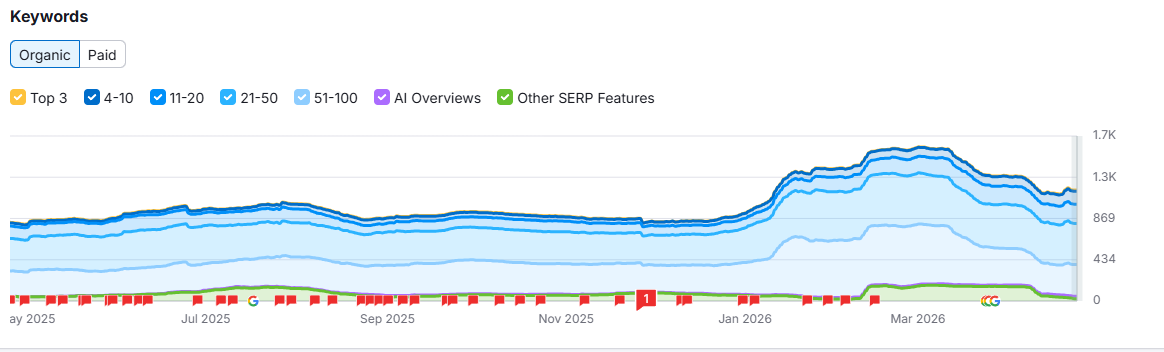
Organic Search Positions: The site went from a handful of tracked rankings to 1,078 organic search positions.
That’s not all gold. Positions 51-100 make up a significant portion but the keyword chart shows a substantial and sustained shift in the 4-10 and 11-20 brackets.
Those are the positions that drive real clicks. The spike that hit around November-December 2025 and held through early 2026 correlates directly with the content volume we’d been building hitting critical mass in Google’s index, compounded by the structured data work starting to pay off.
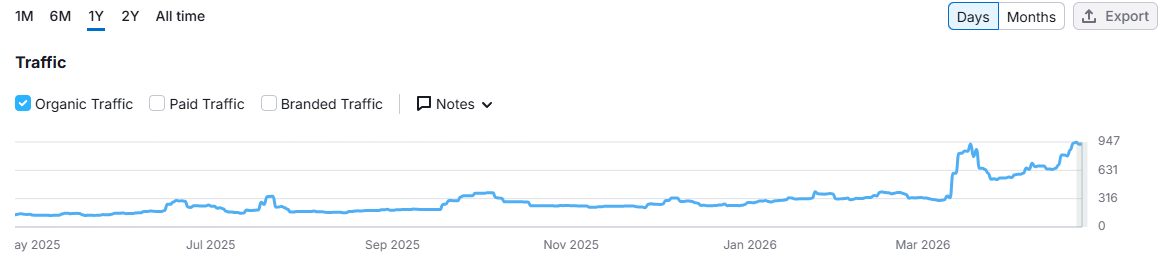
Organic Traffic: Starting somewhere around the 200-300 daily visitor range, the site climbed steadily before a noticeable acceleration beginning around January 2026.
By March-April 2026, peak daily traffic was approaching 947 organic visitors which is nearly a 4x increase from the May 2025 baseline when looking at trend lines.
The curve isn’t perfectly linear, which is honest; SEO rarely is. But the direction is unmistakable and the recent uptick suggests the momentum is continuing rather than plateauing.
AI Visibility: This is the frontier metric, and it tells the most nuanced story. The AI Visibility score sits at 27/100 — rated “Low” and that’s worth being transparent about.
But the trajectory within that score is what matters: Citations grew 36.5% over the six-month tracked window. The firm’s content is now appearing in 116 citations across AI platforms, spread across 44 distinct pages. That’s a meaningful footprint for a local legal services firm in a niche category.
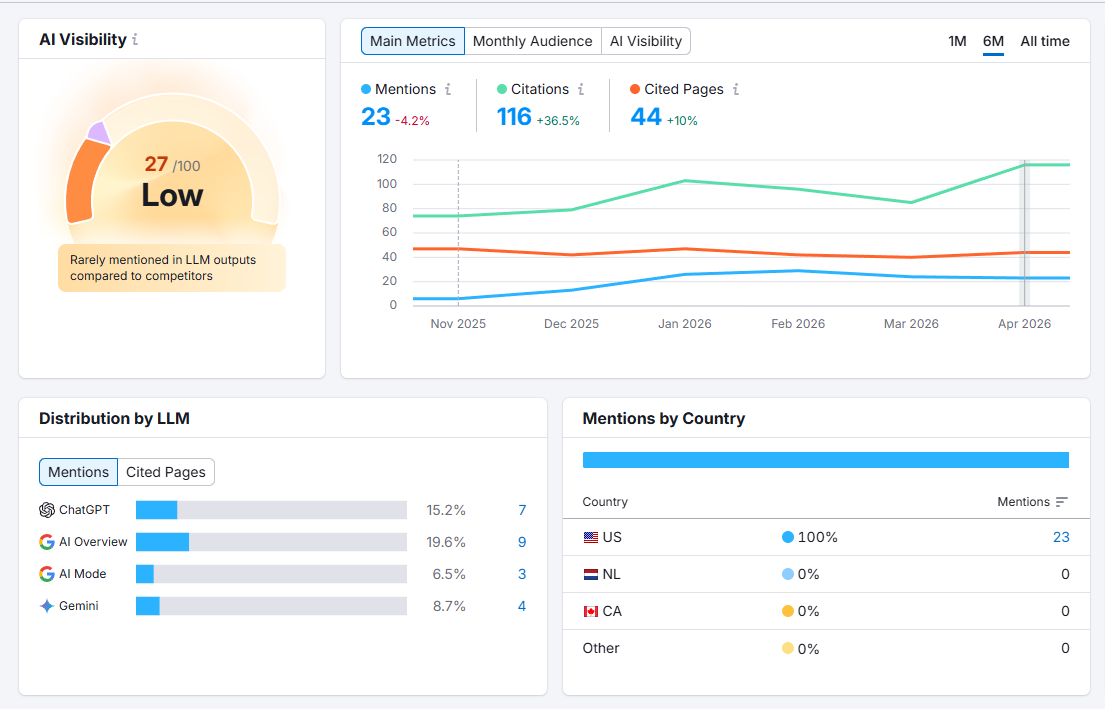
The distribution across LLMs is healthy: Google AI Overview leads at 19.6% (9 mentions), ChatGPT follows at 15.2% (7 mentions), Gemini at 8.7%, and AI Mode at 6.5%.
All 23 direct mentions are US-based, which is expected and appropriate for a firm practicing US immigration law.
The gap between citations (116) and mentions (23) is actually encouraging. It means the firm’s content is being used as reference material by AI systems even when the firm isn’t being directly named, which builds the kind of authority that eventually converts to direct mentions.
What Didn't Go as Planned
– Pitfalls
Honest case studies include this section. Most agencies don’t write it.
The local SEO push for Chicago took longer than projected. The competitive density in “immigration lawyer Chicago” at KD 59 is real, and building the Domain Authority to genuinely compete at positions 1-5 is a longer-cycle effort than 11 months.
We moved from outside the top 20 to positions 7 and 8, which is meaningful progress but not where the client ultimately needs to be for that keyword to drive significant commercial volume.
We also initially underestimated how quickly AI platforms were evolving their citation criteria.
Some content formats we’d optimized for AI Overviews in Q3 2025 needed restructuring by Q1 2026 because the way Overviews pulled and displayed legal content had shifted. That required two rounds of content reformation that weren’t in the original scope.
What I’d do next
– Next priorty
The foundation is solid. The firm now has 1,078 ranking positions generating sustained and growing organic traffic. The AI citation presence, while still developing, is growing in the right direction and the content infrastructure is in place to compound that.
The next phase focuses on three priorities: pushing the Chicago commercial keywords from page 1 positions 7-8 into the top 5 through authority-building and EEAT signal reinforcement, growing AI mentions specifically (not just citations) through more aggressive PR and expert-positioning campaigns.
We will begin developing content targeting the North Carolina market more systematically now that the domain has enough authority to support geographic expansion.