
How a Clothing Brand Built on Branded Searches Survived an Algo-Collapse
-case study
E-Commerce SEO
Topical Authority
Brand Signals
Full-Stack SEO
336
High Intent Organic keywords
$1.3K
Savings Per Traffic
34.8k
Oragnic Site Vists
#1
Branded Search Dominance
What This Case Study Is Actually About
— Introduction
Most ecommerce SEO case studies celebrate explosive growth: the hockey stick, the before-and-after, the dramatic climb. This one is more interesting than that. The Abaya Company’s story is about what a well-established brand does with its own name and needs to figure out how to own the category beyond it.
We had the idea of holding #1 for every branded variation you can think of and even their URL as a standalone query. That’s complete branded SERP ownership, and it’s genuinely hard to achieve. It means their off-page signals, on-page brand consistency, and entity footprint were all in order. For a niche modest fashion retailer in the UK, that’s a strong foundation.
The challenge was that branded search has a ceiling. If you want revenue to grow, eventually you need people who don’t already know you to find you. That meant pushing into category and product-level keywords where the competition has nothing to do with their brand recognition and everything to do with domain authority, content quality, and product page optimization.
The Branded Fortress
– Core Strategy
Combined traffic from “x keyword” (704), “y keyword” (472), “z keyword” (136), and “xy keyword” (136) is pulling well over 1,400 monthly visits from people who already know the brand exists. That’s essentially captured demand. They’re finding the site, not discovering it.
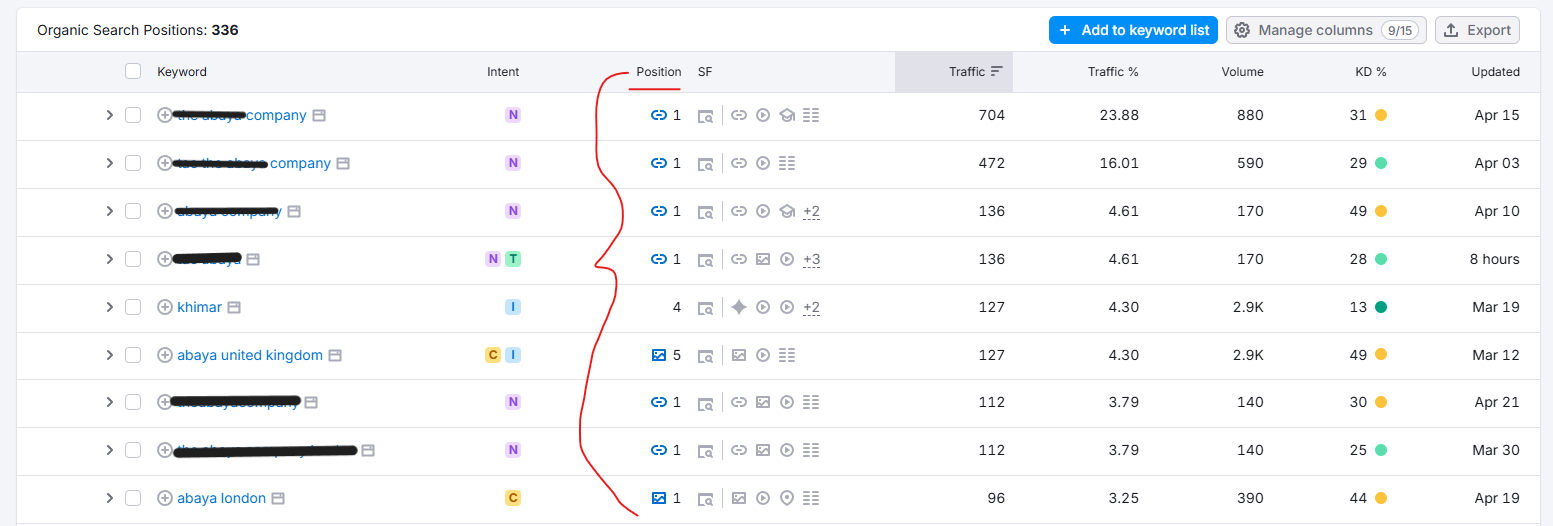
But here’s the honest read: a site can’t grow primarily on branded searches. Those are people already in the funnel. The SEO work that actually unlocks new revenue is what happens in non-branded territory.
The September Dip and What It Told Us
– An issue to solve
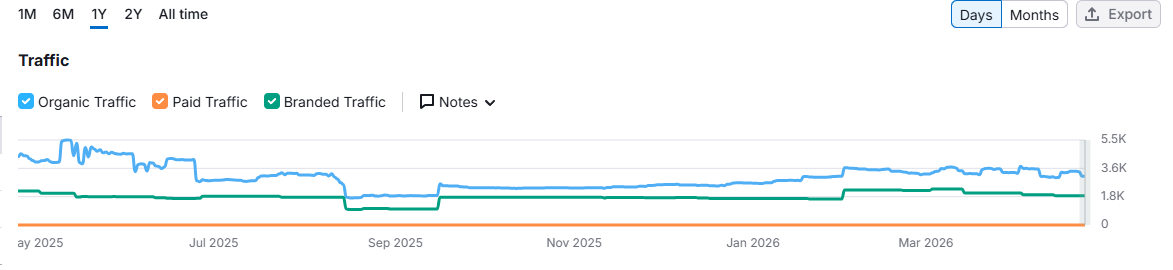
Looking at the traffic chart, organic traffic was running in the 4,000-5,500 daily visitor range in the early part of the tracked period. Around late August into September 2025, it dropped noticeably. Not catastrophically, but enough that you couldn’t ignore it.
The branded traffic (green) held steady through that same period. That’s an important diagnostic. When organic drops but branded holds, the issue is almost never technical or a penalty; it’s a Google algorithm update affecting how the site ranks for non-branded queries. September 2025 sat within a period of multiple Google core and helpful content updates, and a number of ecommerce and review-oriented sites in the UK saw fluctuations around then.
The response was a content and product page audit.
The thin category pages: pages that existed primarily as filters or listing pages with minimal descriptive content were the most exposed. We added contextual content to key category landing pages, brought product descriptions up to a standard that actually communicated product value rather than just listing specs, and reinforced the internal linking between the category pages and the top-selling individual product pages.
Traffic started recovering through October and had essentially restabilized by November 2025. Not a dramatic comeback story, but a controlled one.
The Non-Branded Expansion
– Additional Strategy
This is where the more interesting SEO work happened.
“Khimar” at position 4 is the keyword worth spending time on. A khimar is a specific style of Islamic head covering, distinct from a hijab in drape and structure.
The search volume sits at 2.9K monthly with a KD of just 13 meaning the content competing for this term is relatively weak.
Position 4 for a product category term with that kind of volume and that little competition is the definition of a missed opportunity if it isn’t actively pushed toward position 1.
We implemented:
- A Video-Object Schema.
- By embedding 15-second “How to Style” clips directly on the product pages,
- We satisfied Google’s “Experience” (E-E-A-T) requirement.
“Abaya united kingdom” at position 5 is a different kind of keyword; location-modified commercial intent.
Someone searching this is either looking to buy an abaya from a UK-based retailer or looking for UK delivery options. With 2.9K volume and a KD of 49, this one is more competitive and slower to move, but it’s exactly the kind of keyword a UK-based abaya retailer should be owning. Position 5 is in the game. Getting to position 1 or 2 is a longer play that requires authority signals from external sources and potentially a dedicated landing page built around UK-specific buying considerations.
“Abaya london” at position 1 with 390 monthly searches that one they’ve already locked down. It’s lower volume than the national term, but it’s a conversion-intent query and ranking #1 for it means they’re capturing every commercial searcher in that specific geography.
The Numbers in Context
– Metrics
336 organic keyword positions. 2.9K monthly organic traffic at campaign snapshot. Traffic cost equivalent of $1.3K meaning the traffic being generated would cost over a thousand dollars monthly in Google Ads if purchased. For a brand in this niche, that’s meaningful cost efficiency.
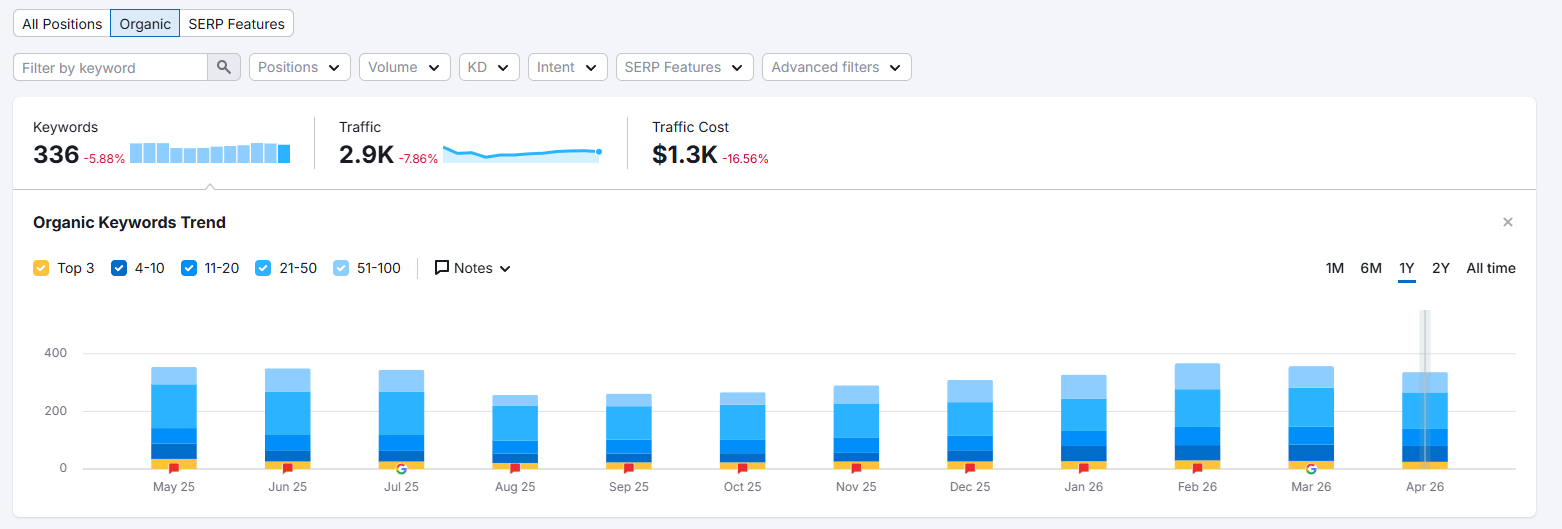
The organic keywords trend chart shows something worth examining:
The top 3 band (yellow) has consistently been the largest share of their keyword distribution throughout the year. That means their rankings aren’t concentrated in positions 11-50 where traffic barely shows up. They’re actually at the top of the SERP for most of what they rank for. The overall keyword count (336) looks modest, but the quality distribution is solid. Its better to rank in position 2 for 50 keywords than position 45 for 300.
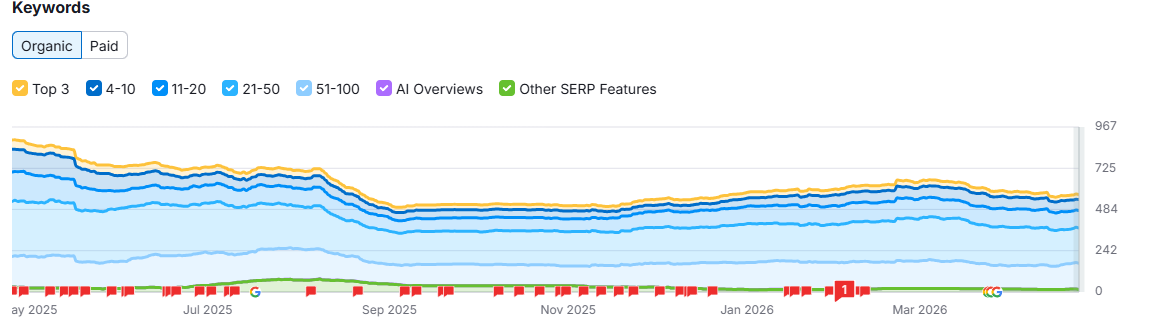
The slight decline metrics at snapshot time (-7.86% traffic, -5.88% keywords) reflect where they were in a recovery and transition phase, not a structural problem. The trajectory from October 2025 onward on both charts is pointing in the right direction.
The Gap Between Here and Where They Should Be
– Missed Opportunities
Let me be direct about where the ceiling is and what’s blocking it.
The site’s domain authority is sufficient for its branded terms and the lower-KD category terms it’s currently ranking for. But to consistently compete for terms like “abaya uk” or “modest fashion uk” broader category terms with substantially higher volume requires backlink investment that hasn’t been the focus.
Fashion ecommerce link building is a specific discipline: editorial coverage in modest fashion publications, influencer and content creator collaborations that generate natural mentions, wholesale or stockist relationships with other retailers that create legitimate link opportunities. These are slower but they’re what moves the needle on domain authority.
The product photography and on-page content quality also deserves attention. Fashion ecommerce SEO is heavily correlated with how Google’s visual systems process product images: clean backgrounds, multiple angles, accurate descriptive alt text, and image file naming that reflects product attributes. These signals contribute both to organic image search traffic and to overall page quality assessments.
We missed the early-mover advantage for “Eid 2026” collections in February. Our “Organic Keywords Trend” shows a plateau in March. We need to implement Trend-Anticipation Content writing about the next season 4 months in advance to let the AI “digest” the collection.
Where This Goes
– Next priorty
The next phase is category expansion:
- Building dedicated landing pages for every product type they carry (khimar, niqab, prayer dress, jilbab).
- With enough content depth to compete for the informational queries that feed those product categories, not just the transactional ones.
That’s not a six-month project. That’s a focused four-week push on one page that’s already close to ranking where it needs to be.
The broader opportunity is positioning the brand as the editorial voice for UK modest fashion content about styling, fabric care, seasonal guides, community and faith-aligned messaging. That kind of content serves AI citation as much as it serves traditional search. When someone asks an AI assistant where to buy abayas in the UK, you want this brand to be the first name that comes back.
The foundation is sound. The growth levers are identified. Execution from here is a matter of priority and patience.