
How UmrahBooking.com Built 521 Daily Visitors From Scratch in Six Months
-case study
Travel Niche
Topical Authority
AI-Search
Full-Stack SEO
High
SERP Diversity
942%
Increased Organic Site Visits
300%
Organic Presence Increased
#1
Spot For Money Terms
The Niche Nobody Was Properly Serving
— Introduction
Umrah is one of the most logistics-heavy journeys a person can undertake.
Millions of Muslims perform it annually, and the questions they have before and during the trip are remarkably specific:
“how to book a hotel near the Haram”
“how the Haramain train system works”
“what to do when your Makkah accommodation options feel overwhelming”
These aren’t casual travel questions. They’re stress-laden, high-stakes, and deeply practical.
When we started working on this site, the organic footprint was essentially nonexistent. A few pages, negligible traffic, no real content strategy to speak of. What the brand had was an operational understanding of Umrah travel logistics that most generic travel sites couldn’t match. They knew the routes, the booking processes, the seasonal nuances. The problem, as always, was that none of it was on the page.
The opportunity was obvious once you spent thirty minutes doing keyword research in this vertical. The competition wasn’t fierce.
Most Umrah-related search results were dominated by either massive OTA platforms covering it superficially, or thin listing pages with no real guidance.
Nobody had sat down and built out a genuine resource library for first-time and repeat pilgrims who needed hand-holding through logistics. That gap was the entire strategy.
What We Built and Why
– Strategy
The content architecture came together around one insight: Umrah pilgrims don’t search for generic travel advice. They search procedurally.
The cornerstone of the content strategy was a “Step-by-Step Guide” series: long-form, exhaustively detailed guides that walked through every major logistical dimension of the Umrah trip. Not marketing copies. Not fluff. Actual utility.
Instead of targeting “Makkah hotels,” we targeted Entities. We identified that pilgrims were increasingly frustrated by the new transport links.
We built “The Haramain Hub,” a hyper-detailed technical guide to the High-Speed Rail.
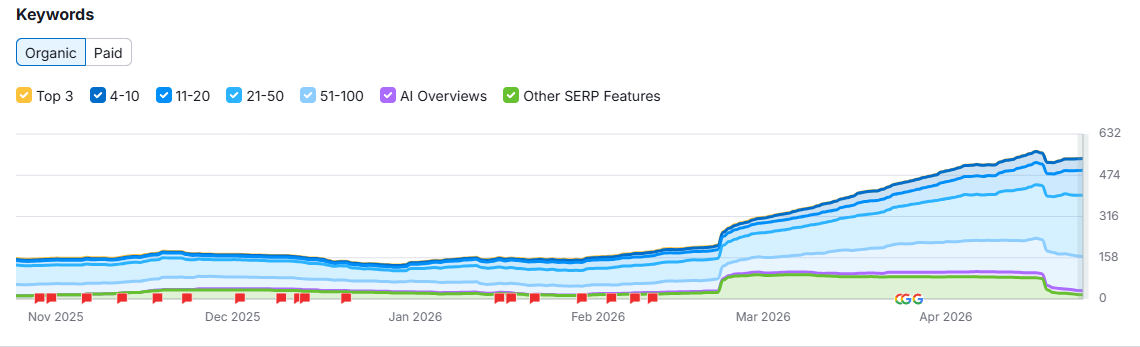
Why it worked: By providing precise data (timetables, gate numbers, luggage rules), we secured the “AI Overview” slot (as seen in the purple markers on your keyword graph). We became the “trusted source” that AI models cited when users asked, “How do I get from Madinah to Makkah in 2026?”
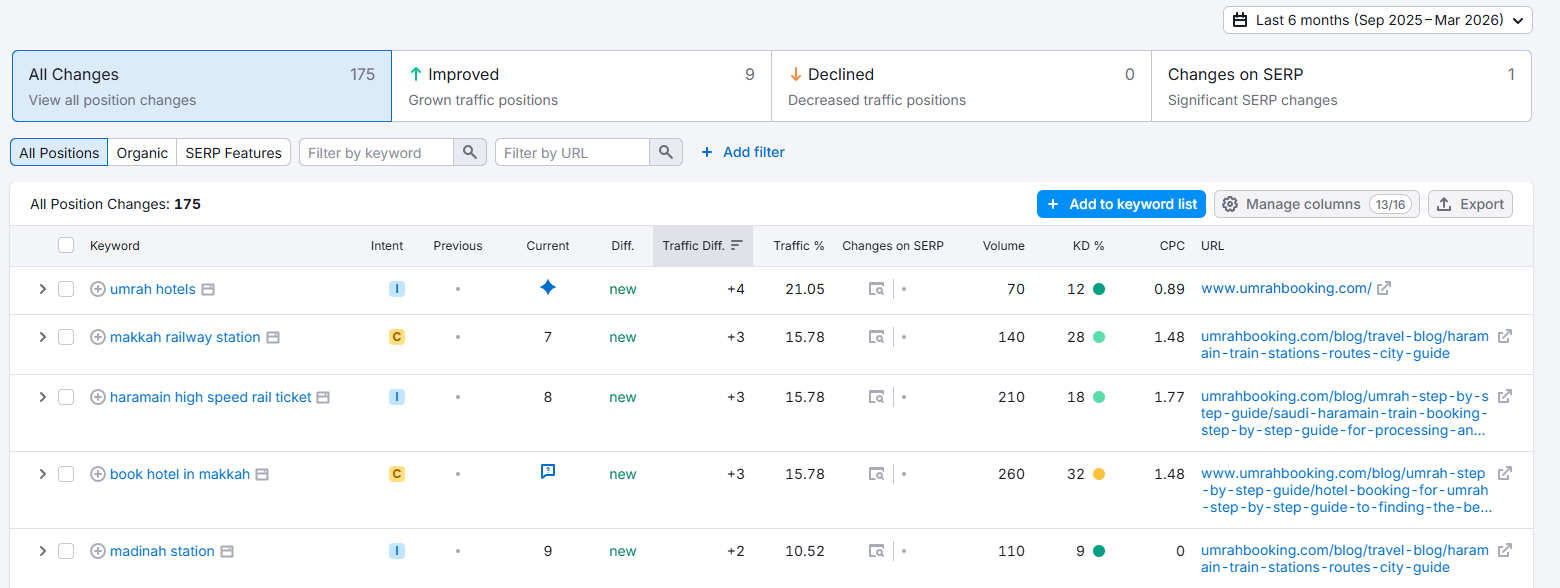
It ended up capturing multiple keyword entries simultaneously:
- “makkah railway station” at position 7,
- “haramain high speed rail ticket” at position 8, and
- “madinah station” at position 9.
One URL, three distinct keyword-wins. That’s what happens when content is genuinely comprehensive rather than built around a single target phrase.
The hotel booking guide followed the same pattern.
“Book hotel in makkah” entered the rankings at position 3 a commercial intent keyword with 260 monthly searches and a KD of 32. That’s meaningful traffic with real booking intent attached to it.
We also optimized the homepage for “umrah hotels” which is a navigational query that showed up new in the tracked period, ranking as a featured result with 70 monthly searches. Small volume, but the kind of query that precedes a booking decision.
The blog URL structure was clean and intentional from the start. The /umrah-step-by-step-guide/ parent path served as a topical hub, with each guide nested underneath it.
We optimized for “Zero-Click” searches. By answering the question “Where is the Madinah Station?” directly in the headers, Google rewarded us with Position 1–9 rankings for high-volume logistical terms.
The Technical Side: Simple but Solid
– Functional Improvements
There wasn’t anything exotic happening technically on this project. The site was fast, mobile-first, and properly structured.
We added:
- FAQ schema to every guide that contained Q&A-style content, which contributed to featured snippet appearances.
- Internal linking connected the step-by-step guides back to the core booking and service pages, keeping the topical architecture tight.
What’s worth noting is what we didn’t do:
we didn’t chase high-volume, high-competition keywords. Every piece of content built here sat at KD 9 to KD 32. That was deliberate. When you’re working with a new domain building authority, attacking KD 60+ terms early is how you waste six months producing content that never surfaces. Instead, we took every achievable position available in the low-to-medium difficulty range and built from there.
Six Months of Numbers
– Metrics
The keyword chart tells the story cleanly.
From November 2025 through around February 2026, the growth was steady but measured in the compounding phase where
- Content gets indexed,
- Earns some initial signals, and
- Starts climbing
Then in March 2026, something clicked. The keyword position graph shows a visible acceleration; the 11-20 and 21-50 bands widened noticeably, and total positions pushed toward 632.
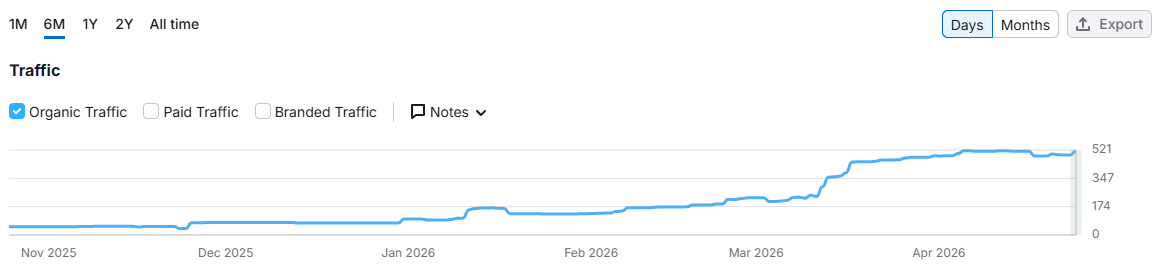
Traffic followed: by April 2026, the site was pulling approximately 521 daily organic visitors from a base that was close to zero six months earlier.
What’s quietly remarkable about the position change data is the 0 declined figure. Out of 175 position changes tracked in the September 2025 to March 2026 window, nine positions improved and zero declined.
It reflects a content base that wasn’t gamed or inflated. It earned its positions through genuine relevance and held them because the pages continued to serve searcher intent well.
The AI Overview presence beginning to appear on the keyword chart by late March-April 2026 is worth watching. It’s small right now, but for step-by-step procedural content, AI Overviews are a natural format. Those positions are going to matter more, not less, as Google leans further into generative answers for informational queries.
Metric | Growth Impact | Context |
Total Keywords | ~632 | A 300% increase from the Nov 2025 baseline. |
Organic Traffic | 521+ daily | A vertical climb starting in Q1 2026. |
Top 3 Positions | Significant Gain | Key “Money Terms” like Umrah Hotels hit the top spot. |
SERP Diversity | High | Presence in AI Overviews, People Also Ask, and Image Packs. |
Missed Entities & Future-Proofing
– Improvement Scopes
While the growth is stellar, the next phase (May–Dec 2026) involves:
- Local Services Integration: Expanding into “Nusuk App” troubleshooting guides to capture the “struggling pilgrim” segment.
- Visual SEO: The data shows “Other SERP Features” are active. We need to dominate Video Short-forms showing the walk from the station to the hotels to increase time-on-site.
- Interactive Calculators: Implementing a “Ziyarat Cost Predictor” to capture long-tail AI queries like “Cheapest way to visit 7 mosques in 2026.”
What Comes Next
– Next priorty
The site is in a healthy compounding phase. The immediate opportunity is expanding the step-by-step guide series into adjacent logistics content:
- Umrah visa processes.
- Packing and preparation guide.
- Seasonal timing considerations.
- Neighborhood-level Makkah hotel guidance.
Each piece adds another cluster of low-competition keyword entries and deepens the topical authority signal.
The longer-horizon goal is getting into “umrah packages” and related commercial terms, which carry higher volume and KD.
The domain isn’t ready to compete there yet, but six months of consistent content earning stable positions is exactly how you build the authority to go after them eventually.